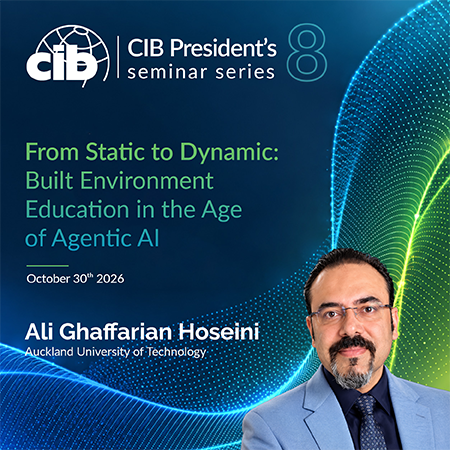
The theme of the 8th CIB President’s Seminar Series is “The impact of research in the built environment sector”, and we have secured speakers from leading CIB members who are delivering significant impact through their research.
Our first seminar in this series is with Ali Ghaffarian Hoseini of Auckland University of Technology.
Date: 30th October 2026 20:00 Auckland (GMT +13)
From Static to Dynamic: Built Environment Education in the Age of Agentic AI
Abstract
Architecture and built environment education runs on fixed curricula, periodic review and reactive partnerships, while the sector it serves moves towards green, digital and intelligent environments shaped by agentic AI. This seminar argues for a different operating model: curricula updated continuously, programmes rooted in industry and end user practice, and staff supported rather than left anxious as change accelerates. Drawing on the School of Future Environments at AUT, it examines how AI reshapes teaching, research and citizenship, why we must move beyond BIM towards digital twins, why publications should become dynamic, and how to lead through uncertainty we cannot remove.
Biography
Professor Ali Ghaffarian Hoseini is a Senior Academic Strategist, Visionary People Leader, and Champion of Transformational Governance with over two decades of experience in academic leadership, steering sophisticated teams and initiatives across Architecture, Construction, Creative Technologies, and Engineering disciplines. He leads the School of Future Environments at Auckland University of Technology, bringing architecture, engineering, construction and creative technologies under one strategic direction.
Beyond the University, he shapes national and international agendas. He advises governments at the highest level on artificial intelligence, serves as an academic voice on the national advisory body for digital construction, and assesses strategic research investments. A globally recognised authority on digital twins, AI and green, digital and intelligent built environments, he founded and chairs several international conference series in the field, holds senior editorial and advisory roles across the discipline, and has authored more than 300 publications attracting over 11,000 citations.