CIB Launches New Report on Passive Energy Conservation Measures for Climate-Resilient, Low-Carbon Buildings
CIB is pleased to announce the publication of a new report from Working Commission W040 – Heat and Moisture Transfer in Buildings, examining how passive energy conservation measures (ECMs) can support climate-resilient, energy-efficient and low-carbon buildings in a changing climate.
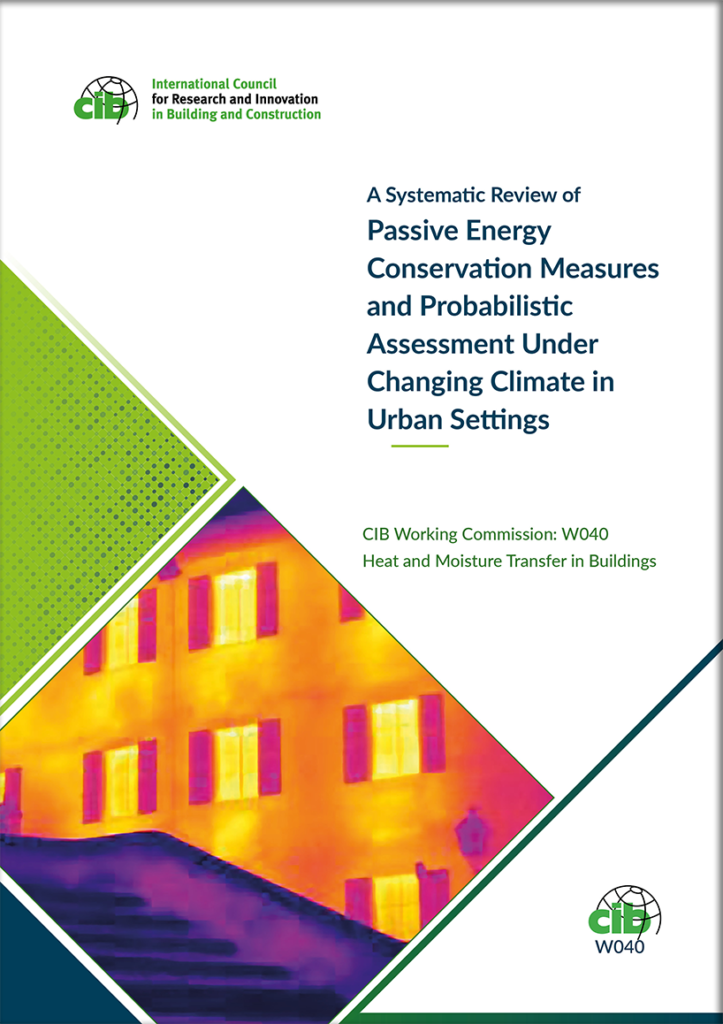
As the first output of W040’s 2025–2028 working programme, the report lays the foundation for a long-term research roadmap focused on practical solutions that help the construction sector address the dual challenges of climate change adaptation and decarbonisation.
The report presents a comprehensive review of passive ECMs used in urban environments, including insulation strategies and passive cooling measures that influence heat, air and moisture transfer in and around buildings. These approaches play a critical role in reducing heating and cooling energy demand while improving thermal comfort, moisture safety and overall building performance.
Recognising that building performance is highly dependent on climate conditions, the report explores the benefits, limitations, uncertainties and potential risks associated with different passive energy conservation measures under future climate scenarios. It also reviews the use of advanced building performance assessment methods, including hygrothermal simulation, probabilistic modelling, and Monte Carlo-based analysis, which are increasingly used to support evidence-based building design and retrofit decisions.
To help practitioners prepare for future climate conditions, the report further examines the selection and application of future climate data and reference years for building performance simulations.
Designed for both built environment researchers and industry practitioners, the report provides valuable insights for those developing building design, retrofit and climate adaptation strategies, while also identifying future research opportunities to advance knowledge in climate-resilient construction and sustainable building performance.
By bringing together current evidence on passive energy conservation measures and future climate impacts, this report contributes to the development of more resilient, energy-efficient and low-carbon buildings, supporting the transition towards a sustainable built environment.
Report Editors and Authors
The report is the work of a number of researchers, and the full list can be viewed at the bottom of this post. Editing the report were Lin Wang, National Research Council Canada, Magda Posani, Aalto University, Finland and Jiwei Zou, The Hong Kong Polytechnic University, China



“For over fifty years, CIB W040 has advanced research in heat and moisture transfer in buildings, helping establish the foundations for building physics and positioning itself to address emerging challenges of decarbonization and sustainability.
This report provides a state-of-the-art review of passive energy conservation measures under a changing climate in urban environments. By identifying emerging research opportunities, it marks a new chapter for W040 to address the challenges of energy efficiency, lifecycle management, and human well-being, advancing building physics for low-carbon and sustainable built environments.”
Lin Wang
Coordinator CIB W040 – Heat and Moisture Transfer in Buildings
List of Authors
| Name | Organisation | Country |
|---|---|---|
| Jingjing An | Beijing University of Civil Engineering and Architecture | China |
| Elif Esra Aydin | Singapore University of Technology and Design | Singapore |
| Canan Bas | Istanbul Technical University | Turkey |
| Dario Bottino-Leone | Eurac Research | Italy |
| Fabiana Convertino | University of Bari Aldo Moro | Italy |
| Tayma Dadssi | Aalto University | Finland |
| Xinyuan Dang | KU Leuven/University College Dublin | Belgium/Ireland |
| Yifan Fan | Zhejiang University | China |
| Hua Ge | Concordia University | Canada |
| Payam Gholamalipour | Concordia University | Canada |
| Praveen Govindarajan | Singapore University of Technology and Design | Singapore |
| Max Junginger | Concordia University | Canada |
| Targo Kalamees | Tallin University of Technology | Estonia |
| Aslihan Karatas | University of Illinois Chicago | USA |
| F. Peter Ortner | Singapore University of Technology and Design | Singapore |
| Magda Posani | Aalto University | Finland |
| Sina A. Shams | Concordia University | Canada |
| Zheng Tan | The Hong Kong Polytechnic University | China |
| Xiaoliang Teng | Zhejiang University | China |
| Nathan Van Den Bossche | Ghent University | Belgium |
| Stéphanie Van Linden | Ghent University | Belgium |
| Lin Wang | National Research Council Canada | Canada |
| Liangzhu (Leon) Wang | Concordia University | Canada |
| Da Yan | Tsinghua University | China |
| Shujie Yan | The Hong Kong Polytechnic University | China |
| Liqi Zhang | Kochi University | Japan |
| Xin Zhang | Kochi University | Japan |
| Jiwei Zou | The Hong Kong Polytechnic University | China |
Download the report and learn how passive building strategies can support climate adaptation and decarbonisation in the built environment.