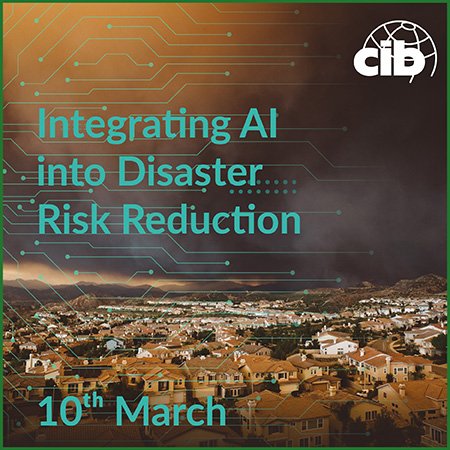
We are pleased to invite you to the upcoming CIB W120 Disasters and the Built Environment online seminar titled Integrating Artificial Intelligence into Disaster Risk Reduction: A Global Review and Empirical Insights from Australia’s Multi-Sector Adoption.
Details
Tuesday, 10th March 2026 at 6:00 – 7:00 PM (AEDT)
Seminar overview
As disaster risks continue to escalate globally due to climate change and increasing exposure, there is a growing need for more accurate, timely, and evidence-based decision-making. Artificial intelligence has the potential to significantly transform disaster risk reduction by improving prediction accuracy, spatial resolution, and early-warning capabilities. However, despite rapid advances in AI research, its practical adoption, particularly within public-sector disaster management remains limited and uneven.
This seminar will present findings from a collaborative research project that combines a global systematic review of over 200 studies with empirical insights drawn from interviews across government agencies, universities, and private-sector organisations in Australia. The research highlights a striking implementation gap between sectors, revealing how institutional structures, procurement processes, infrastructure limitations, and regulatory requirements constrain the operational use of AI, despite its proven technical potential.
The presentation will be delivered by Nilantha Randeniya, a PhD researcher at the Global Disaster Resilience Centre, University of Huddersfield, within the School of Applied Sciences. His research focuses on the ethical and effective integration of artificial intelligence into climate modelling and disaster risk reduction, with a strong commitment to translating research into real-world policy and practice.
This work is the result of a multi-institutional research collaboration involving leading scholars in disaster resilience, construction, and governance:
- Professor Richard Haigh, Global Disaster Resilience Centre, University of Huddersfield, whose work focuses on disaster resilience, policy integration, and international frameworks for risk reduction.
- Professor Dilanthi Amaratunga, Loughborough University, a globally recognised expert in disaster resilience, gender, and sustainable development.
- Professor Srinath Perera, Western Sydney University, specialising in construction innovation, systems thinking, and policy-oriented research.
- Dr Krisanthi Seneviratne, Western Sydney University, whose research focuses on smart construction, digital innovation, and applied sustainability.
- Dr Sameera Wijesiri Pathirana, Western Sydney University, with expertise in technology adoption, built environment systems, and applied analytics.
Together, this interdisciplinary team brings perspectives from disaster resilience, artificial intelligence, governance, and the built environment to examine not only what AI can do, but what it takes for AI to be responsibly and effectively adopted in real-world disaster management.
We look forward to an engaging discussion on how collaborative, cross-sector approaches can help bridge the gap between AI innovation and practical disaster risk reduction.
Speaker biography
Nilantha Randeniya is a Doctoral Researcher at the Global Disaster Resilience Centre, University of Huddersfield, UK. His research focuses on the use of artificial intelligence and advanced spatial analytical methods to enhance the accuracy of climate change impact prediction, particularly in the context of disaster risk reduction. He has experience in teaching and mentoring students and is attentive to the ethical and societal implications of AI in climate modelling. Nilantha is committed to translational research, bridging the gap between theory, data-driven prediction, and real-world policy and practice. He aims to contribute to resilient communities through rigorously validated models and meaningful interdisciplinary collaborations. He is also a tutor at Manchester Metropolitan University International College.

Looking ahead
This seminar is part of the CIB W120 Seminar Series, connecting researchers and practitioners committed to improving resilience in the built environment. Future sessions will highlight innovative approaches and research collaborations that advance disaster risk reduction globally.