The theme of the 7th CIB President’s Seminar Series is “The impact of research in the built environment sector”, and we have secured speakers from leading CIB members who are delivering significant impact through their research. Seminars from the previous series can be viewed here.
The impact of research in the construction and built environment sector is most critical in addressing the “triple bottom line” of sustainability, safety, and economic efficiency. Ultimately, impactful research bridges the gap between academic theory and sector application, whether through improving practice or policy, ensuring that every structure contributes to a safer, smarter, and more sustainable future. This builds on CIB’s existing emphasis on contributions to the Sustainable Development Goals (SDGs) and on research that benefits society.
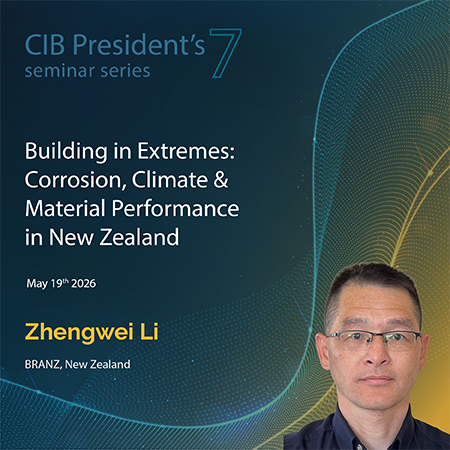
Building in Extremes: Corrosion, Climate & Material Performance in New Zealand
May 19th 2026 8.00 pm New Zealand (GMT+12)
New Zealand is a challenging place to build, with a performance-based building code and highly diverse environments that drive significant variation in material degradation. BRANZ’s corrosion research focuses on understanding how materials perform in New Zealand’s built environment.
This presentation highlights case studies including the updated New Zealand atmospheric corrosivity map, corrosion extremes on the wind-exposed Chatham Islands in the South Pacific, and material performance in geothermal areas. Together, these examples showcase how BRANZ research translates science evidence into practical guidance – shaping national standards, informing local policy, and strengthening the resilience of New Zealand’s built environment under a changing climate.
Speaker

Dr Zhengwei Li has a background in materials science and engineering. In his role at BRANZ, he focuses on understanding the corrosion performance and durability of materials in New Zealand’s diverse and challenging built environments, particularly as the climate changes. His work combines real‑world exposure studies with emerging technologies such as machine learning and big data analytics.
His work has informed material specifications and supported building code durability compliance, helping improve the resilience of New Zealand built environment. He also works closely with like-minded researchers, industry experts, and community groups to understand how material degradation affects our living environment