
Coordinators
- Dr. Suranga Jayasena – University of Moratuwa
- Prof. Bankole O. Awuzie – University of Johannesburg
- Emeritus Prof. George Ofori – London South Bank University, UK
- Dr. Dilani Abeynayake – University of Moratuwa
- Prof. Anuradha Waidyasekara – University of Moratuwa
Background information
CIB Task group 129 Urban-Rural Built and Natural Environment Synergies (URBANES) investigates the socio-economic and managerial frameworks necessary to operationalize a symbiotic relationship between urban demand and rural supply in the built environment.
While built environment studies often treat urban and rural areas as separate domains, this group focuses on the metabolic economics of their integration. The group emphasizes the role of life-cycle costing, circular procurement, and commercial management in facilitating “Nature-Positive” development. It seeks to redefine national, regional and global value chains by treating rural regions as regenerative assets worthy of synergistic development rather than just resource extraction or waste disposal zones.
The group is a transdisciplinary network, bringing together global experts in building economics, construction project management, architecture and engineering to overcome socio-economic, technological, financial and logistical barriers to regenerative construction, thereby aligning the built environment’s economic output with planetary health aspirations and global decarbonization targets.
Objectives
- Translating Earth System Boundaries into actionable targets: Address the concepts of Planetary Health and Planetary Boundaries and formulate actionable KPIs for the built environment, specifically focusing on how urban-rural synergies can mitigate risks related to land-use and resource depletion and how public and private sectors can work for high impact built-natural environment societal benefits.
- Regenerative Value-Chain Modelling: To develop economic models that treat rural landscapes as regenerative assets, creating a financial “business case” for urban projects that invest in rural natural capital and developing human capital for mutual benefits.
- Advancing Circular & Bio-based Procurement: To investigate the commercial and logistical frameworks required to scale the use of rural-sourced bio-materials, ensuring they meet urban regulatory, quality, and performance standards.
- Standardizing Carbon-Integrated Accounting: To develop frameworks for Life Cycle Costing (LCC) that incorporate the carbon sequestration value of rural sources, effectively aligning project budgets with global decarbonization targets.
- Global Knowledge Mobilization via the annual World Construction Symposium (WCS) conference: To institutionalize the WCS as the leading global venue for peer-reviewed research and practitioner dialogue on the socio-economic and logistical management of urban rural-synergies, along with establishing this task group and the and the envisaged future Working Commission as the ‘go-to’ knowledge building and dissemination forum for this purpose.
Scope of work
- Building Economics: Life cycle costing, natural capital accounting, and “carbon bill of quantities” (CBQ).
- Construction Project & Commercial Management: Circular supply chain logistics, regenerative procurement routes, and contract forms (e.g., incentive-based green contracts).
- Asset & Facilities Management: Post-construction performance monitoring of nature-positive assets and their impact on local rural-urban ecosystems.
- Decision Support: Digitalization (e.g. AI, BIM, and Digital Twins) to manage the “metabolic flows” between urban demand and rural supply.
- Relevant future developments on significant aspects related to all of the above.
Planned activity
- The TG intends to hold regular online meetings with members at least annually, but initially bi-annually.
- The TG will organize a session in the annual World Construction Symposium (WCS) series organized by the Department of Building Economics, University of Moratuwa in collaboration with Ceylon Institute of Builders (CIOB). In addition, the TG will propose guest editors to compile a BEPAM journal Special Issue to capture and share knowledge in this proposed high impact domain.
- The TG will conduct a webinar as part of the annual World Construction Symposium (WCS) series organized by the Department of Building Economics, University of Moratuwa in collaboration with Ceylon Institute of Builders (CIOB), whenever possible to align the theme of the annual conference with the scope of the TG.
- The TG will actively participate in; and host a session the triennial World Building Congress series organized by the Department of Building Economics, University of Moratuwa in collaboration with Ceylon Institute of Builders (CIOB)
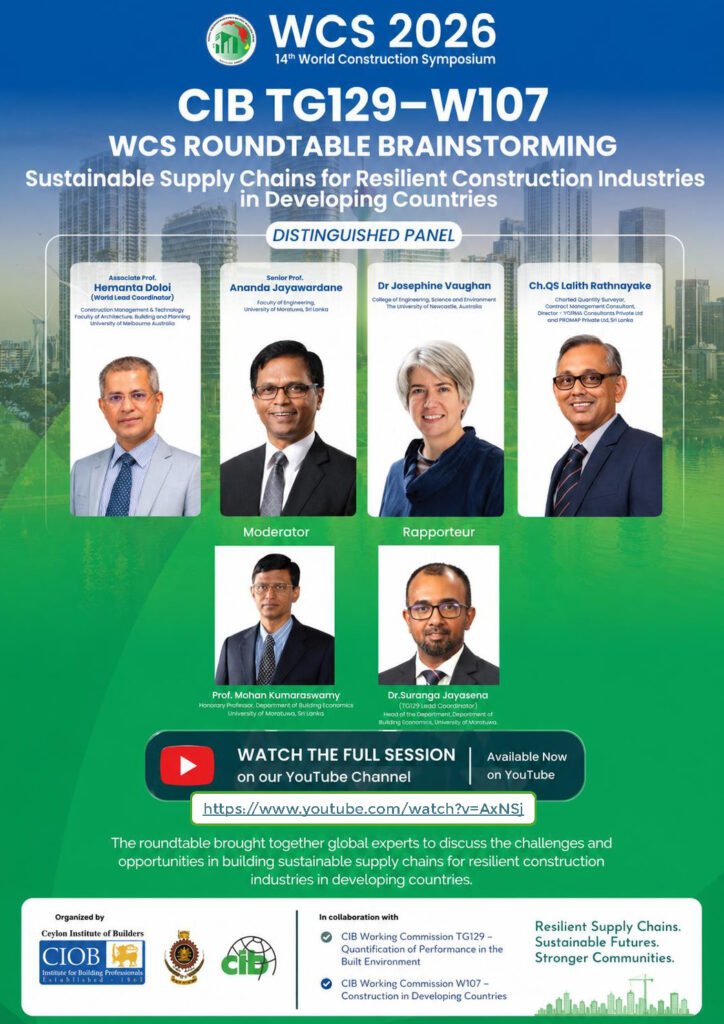
14th World Construction Symposium
The full list of CIB Working Commissions and Task Groups is available here.