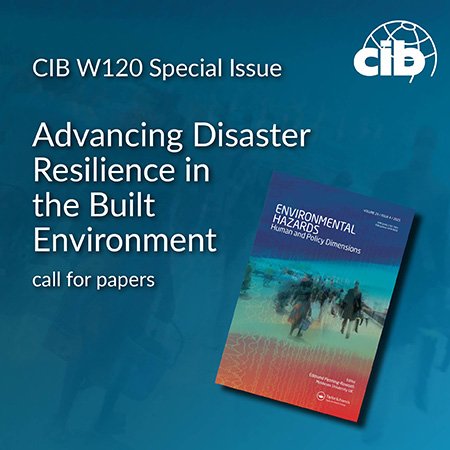
CIB W120 – Disasters and the Built Environment coordinators are pleased to invite you to contribute to a Special Issue in the Taylor and Francis International Journal, Environmental Hazards [Impact Factor 1.7; CiteScore (Scopus) 6.1, Q1], titled “Advancing Disaster Resilience in the Built Environment: Human-Centred, Policy-Driven and Transformative Approaches under Climate Extremes”
Aim of the Special Issue
Research on built-environment resilience has grown across engineering, climate adaptation, nature-based solutions, and social vulnerability, alongside rapid advances in digital tools. However, key gaps remain in multi-hazard integration, long-term evidence for nature-based and digital interventions, equity-focused evaluation, Global South and Indigenous perspectives, and scalable governance and financing pathways for transformative recovery.
The Special Issue brings together previously fragmented research into a cohesive, transdisciplinary agenda focused on practical impact. It advances policy-relevant, systems-level resilience by integrating multi-hazard modelling, long-term evaluation of nature-based and hybrid solutions, critical analysis of AI governance and equity, justice-oriented evidence from underrepresented contexts, and pathways for transformative post-disaster recovery. Through diverse methods, comparative perspectives, and practitioner-focused outputs, it strengthens links between theory and practice while reducing geographic and disciplinary bias.
By bringing together research from engineering, planning, environmental science, and social studies, the Special Issue aims to provide practical insights that help communities and organisations prepare for a future with more complex climate risks.
Anticipated Themes
This Special Issue explores how communities, buildings, and infrastructure can better cope with the increasing impacts of extreme weather and climate-related disasters. The Special Issue examines five areas that are essential for creating safer and more resilient places. These include:
- Understanding how combined hazards disrupt built environment
- Using nature-based solutions to reduce risks
- Addressing fairness and equity in how communities prepare for and recover from disasters
- Applying new technologies such as digital twins and artificial intelligence to support planning
- Improving long-term recovery and rebuilding after disasters.
Special Issue Guest Editors
Professor Temitope Egbelakin is a world-class researcher with expertise in disaster resilience, construction management, climate change adaptation, heritage preservation and gender and equity. She is a coordinator of CIB W120: Disasters and the Built Environment.
Dr. Krisanthi Seneviratne is a Senior Lecturer in Construction Management at Western Sydney University. She is a coordinator of CIB W120: Disasters and the Built Environment.
Deadline
Paper Submission Deadline: 31 August 2026
Further information and submission instructions are available: https://think.taylorandfrancis.com/special_issues/advancing-disaster-resilience-built-environment/