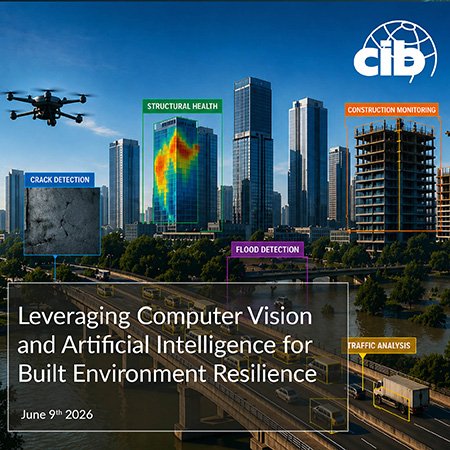
CIB W120 – Disasters and the Built Environment is hosting a seminar on 9th June 2026 (6.00-7.00 PM (AEST)) on Leveraging Computer Vision and Artificial Intelligence for Built Environment Resilience.
As climate and disaster risks intensify, the built environment sector is under growing pressure to assess damage quickly, understand vulnerability better, and support faster, more informed recovery. Advances in computer vision and artificial intelligence (AI) offer promising new tools to complement conventional engineering practice, particularly where manual assessment is time-consuming, resource-intensive, and difficult to scale.
This presentation shares three case studies that illustrate how AI-based image recognition can support built environment resilience across different applications. One case study examines the use of convolutional neural networks (CNNs), specifically VGG-16, for post-earthquake damage classification using images of damaged structures from the Philippines and the PEER Hub Image-Net dataset. The model achieved promising results in classifying building damage states, highlighting both the potential and current limitations of AI for rapid post-disaster reconnaissance.
Beyond damage assessment, the presentation also explores how computer vision can be used for building feature characterisation and structural typology identification, which are important for vulnerability analysis, risk modelling, and resilience planning. Taken together, these case studies show how AI can help improve the speed, consistency, and scalability of built environment assessment, while also raising important questions around data quality, transferability, and integration with expert judgement.
Speaker

Harold Aquino is a Lecturer in Built Environment at Massey University with over 15 years of experience spanning teaching, research, and consultancy in construction, infrastructure planning, and disaster resilience.
His expertise lies at the intersection of engineering design, climate and seismic risk, and data-driven decision support. He has been a consultant on projects by the World Bank and the ICRC on infrastructure resilience projects and risk-informed development planning.
Harold’s current research explores the integration of AI, robotics, and computer vision into damage assessment and building vulnerability characterisation, aiming to enhance the resilience of the built environment in the face of growing climate and disaster risks.