The theme of the 7th CIB President’s Seminar Series is “The impact of research in the built environment sector”, and we have secured speakers from leading CIB members who are delivering significant impact through their research. Seminars from the previous series can be viewed here.
The impact of research in the construction and built environment sector is most critical in addressing the “triple bottom line” of sustainability, safety, and economic efficiency. Ultimately, impactful research bridges the gap between academic theory and sector application, whether through improving practice or policy, ensuring that every structure contributes to a safer, smarter, and more sustainable future. This builds on CIB’s existing emphasis on contributions to the Sustainable Development Goals (SDGs) and on research that benefits society.
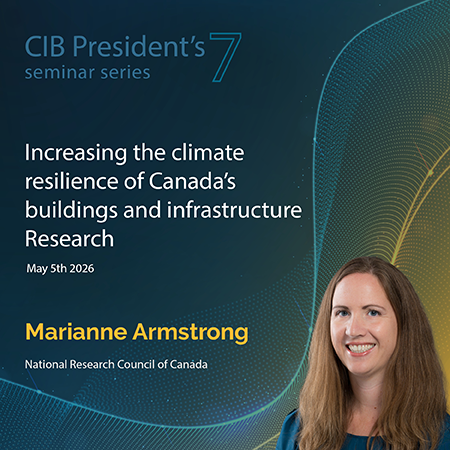
Increasing the climate resilience of Canada’s buildings and infrastructure
May 5th 2026 9.00 am Ottawa (GMT-4)
For the past decade, researchers at the National Research Council of Canada, in collaboration with Housing Infrastructure and Communities Canada, have been developing the tools, technologies and guidance to increase the resilience of infrastructure and buildings to climate change and weather extremes. The effort has involved over 100 researchers across multiple disciplines, and over 200 different collaborators including academia, asset owners, professional organizations, and local governments. This presentation will highlight some of the achievements, the key lessons learned on informing real world change through research, and remaining challenges in helping the construction sector to adapt.
Speaker

Marianne Armstrong is Director of the National Research Council of Canada’s (NRCC’s) Climate Resilient Built Environment Initiative. Since 2016, she has led the national research program to increase the resilience of Canada’s infrastructure and buildings to climate change and extreme events, helping to shape national guidance, standards and codes. Ms. Armstrong has built her career at NRCC over the past 25 years, with research expertise in building envelope and materials, and residential energy technologies. She is a Professional Engineer, holds a MSc in Industrial Design from University of New South Wales, Australia, and a BSc in Mechanical Engineering from Queen’s University, Canada.